
The wine regions of the Alpine arc
Wine is traditionally understood through political geography. Alpina Vina takes a different view. The Alps form a coherent mountain landscape that crosses the boundaries of France, Switzerland and Italy, and within it, a remarkable family of wines has evolved over millennia, shaped by shared geology, climate, indigenous grape heritage and a cultural connectivity that predates modern nation states.
To identify which regions belong to this category, we drew on the OIV's 2010 definition of terroir: "Vitivinicultural terroir is a concept which refers to an area in which collective knowledge of the interactions between the identifiable physical and biological environment and applied viticultural practices develops, providing distinctive characteristics for the products originating from this area. Terroir includes specific soil, topography, climate, landscape characteristics and biodiversity features."
Applied to the Alpine arc, this points to nine regions: Savoie, Chablais, Valais, Ticino, Graubünden, Valle d'Aosta, Valtellina, Alto Adige / Südtirol and Trentino. Together these regions encompass some 26,000 hectares of mountain vineyard, over a hundred indigenous grape varieties and eight linguistic traditions. Production is often limited and exports sparse. Alpina Vina exists to make these regions, their wines and their producers accessible, and to make the case that Alpine Wine is one of the most important and under-recognised categories in the world.
To identify which regions belong to this category, we drew on the OIV's 2010 definition of terroir: "Vitivinicultural terroir is a concept which refers to an area in which collective knowledge of the interactions between the identifiable physical and biological environment and applied viticultural practices develops, providing distinctive characteristics for the products originating from this area. Terroir includes specific soil, topography, climate, landscape characteristics and biodiversity features."
Applied to the Alpine arc, this points to nine regions: Savoie, Chablais, Valais, Ticino, Graubünden, Valle d'Aosta, Valtellina, Alto Adige / Südtirol and Trentino. Together these regions encompass some 26,000 hectares of mountain vineyard, over a hundred indigenous grape varieties and eight linguistic traditions. Production is often limited and exports sparse. Alpina Vina exists to make these regions, their wines and their producers accessible, and to make the case that Alpine Wine is one of the most important and under-recognised categories in the world.
Alpine wine regions map
Important reading information for all maps on this site
- Screen Display: Rendering may vary depending on your screen resolution.
- General Map: Zones correspond to AOC/DOC appellations.
- Regional Map: Only major geographical areas are shown to avoid visual overlapping of appellations.
- Sub-regional Map: Visible plots represent cadastral zones, regardless of whether they are currently planted.
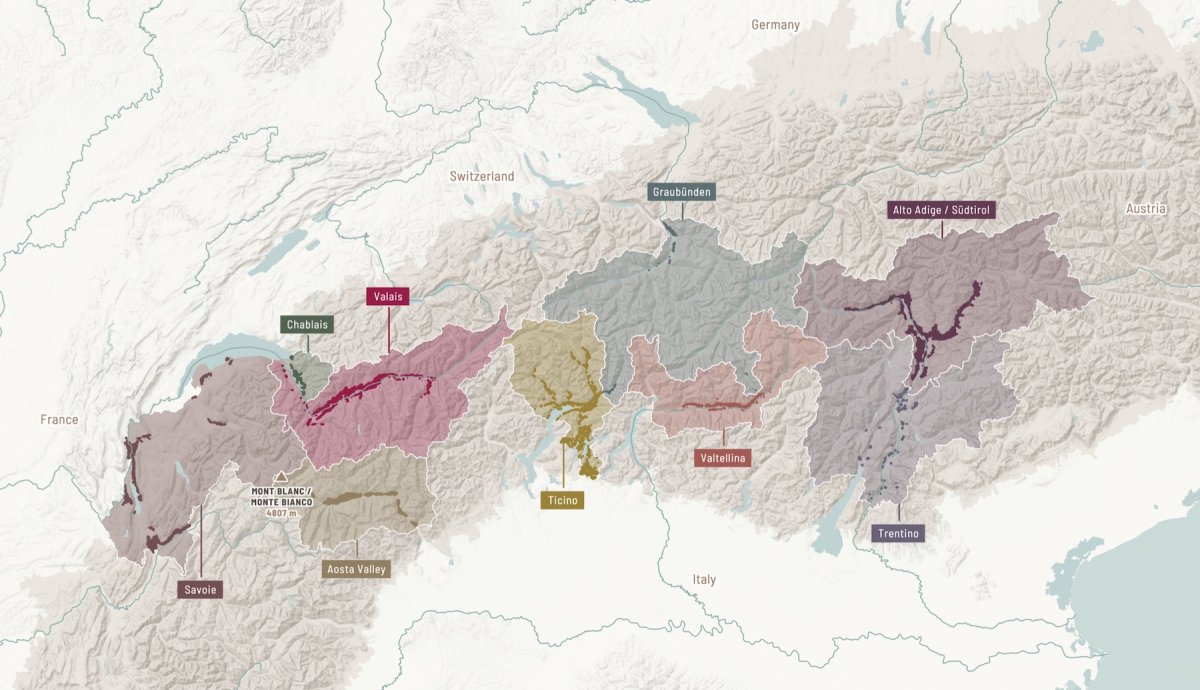
Alpine wine regions data
Regions |
Country | Surface |
|---|---|---|
| Italy | 10'232 ha 39.1% |
|
| Italy | 5'850 ha 22.4% |
|
| Switzerland | 4'578 ha 17.5% |
|
| France | 2'108 ha. 8.1% |
|
| Switzerland | 1'115 ha 4.3% |
|
Italy |
820 ha 3.2% |
|
| Switzerland | 590 ha 2.3% |
|
Switzerland |
450 ha 1.7% |
|
Italy |
404 ha 1.5% |
|
TOTAL |
26'177 ha |